Quarry Garden
Hallowe'en PartyQuarry Garden is a landscaped hollow made from the disused quarry at Quarry House, where Mrs Llewellyn-Smythe turned an abandoned industrial space into a garden of deliberate beauty. Designed by Michael Garfield, it is both a substantial work of patronage and a setting in which Hercule Poirot’s appreciation of the landscape intersects with his thoughts about a forged will and the girl who disappeared in its favor.
Creation and Commission
After her health failed, Mrs Llewellyn-Smythe came to live near her nephew and niece, the Drakes, and bought Quarry House. The property included a disused quarry that she saw as having possibilities. She spent thousands of pounds transforming it into what she called a sunk garden, hiring a landscape gardener from somewhere such as Wisley to design it.
That designer was Michael Garfield, a professionally qualified young artist whom Mrs Llewellyn-Smythe brought to the site and paid a substantial fee. Her support extended beyond the commission: she also had a house built for him. Poirot’s judgment, as he looked around, is unambiguous: Garfield had not failed his patron.
Design and Seasonal Character
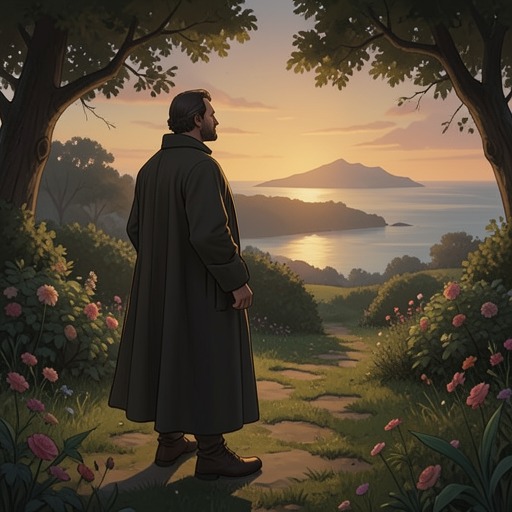
The garden’s defining form is its sunken setting: a former quarry converted from rough stone and industrial possibility into a planted landscape. Its design makes the change feel almost like an act of enchantment. In the spring, Poirot imagines, young beeches and birches, thorn bushes, white roses, and small junipers would shape the scene; in autumn, the garden has its own display, with the gold and red of acers, a parrot or two, and a winding path leading onward.
The planting also shows the limits of Poirot’s botanical knowledge. He recognizes few shrubs and flowers beyond roses and tulips, and cannot confidently name gorse or Spanish broom. His response rests less on classification than on the garden’s composition and effect: this is a place made to offer successive visual delights, not simply a quarry planted over.
Poirot’s Visit and Associations
When Poirot visits, he descends a path through trees and shrubs before stopping to think. The landscape does not distract him from the case: it brings into focus two connected facts, a forged will and a girl who has disappeared, the very girl in whose favor the will was forged. The garden thus frames a pause in the investigation, where beauty and unresolved evidence occupy the same space without being confused with one another.
The name Sunk Garden leads Poirot to recall a garden he once saw in Ireland and to remember that Mrs Llewellyn-Smythe had taken a National Trust tour of Irish gardens. He wonders whether that particular Irish garden may have inspired her to create one of her own. This remains his conjecture, but it gives the commission an imaginative history: the quarry’s design may have carried the impression of another landscape into the grounds of Quarry House.
Meeting Garfield
At the garden, Poirot encounters a young man who says that lovers do not come there because the place is supposed to be unlucky for them. Poirot guesses that he may be the architect, then gestures around the garden and asks whether he made it. The young man identifies himself as Michael Garfield, confirming the connection Poirot had inferred between the landscape and its designer.
The encounter brings the garden’s two kinds of significance together. It is an accomplished work created through Mrs Llewellyn-Smythe’s wealth and Garfield’s professional skill, but it is also a place Poirot reads while turning over a disappearance and a forged document. Its carefully cultivated beauty stands beside the unresolved human story that has brought him there.